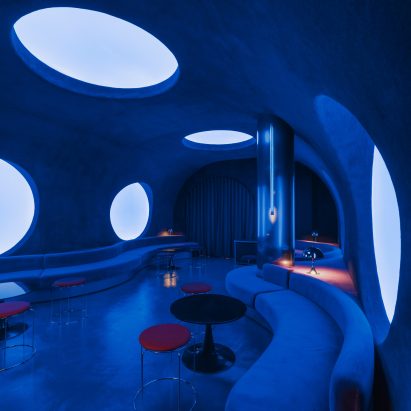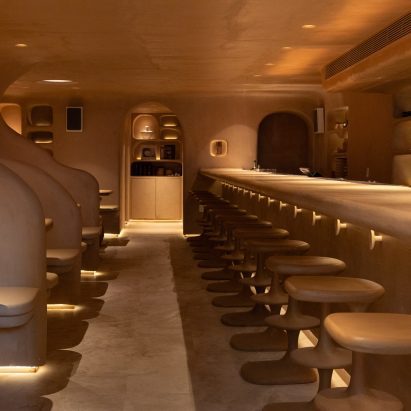
Wild Form Design Studio has created a sculptural, curve-filled interior for Love Thy Neighbor, an all-day bar next to New York's Stonewall Inn that the team says "celebrates the queer community." Guided by an ethos of "no straight lines," the West Village space opened ahead of this year's Pride celebrations, sitting beside the landmark where the 1969 uprising helped galvanize the modern gay rights movement.

A space built entirely around curves
Founders Shigefumi Kabashima and Elias Popa wanted both the design and the hospitality to honor the location's history. Curvaceous walls and partitions shape an intimate, cavern-like room for 40 guests, with warm beige tones flowing across banquettes on one side and the bar on the other. Behind the counter, back-lit shelves slant and dip to extend the free-form visual language across every surface.
"The idea of 'no straight lines' became a guiding principle for us," Kabashima said. "It reflects not only the design of the space, but also how we think about hospitality: fluid, open, and without boundaries." For more interiors and design showcases, see our reviews and showcases.
History woven into the details
The bar embeds references to the site's significance throughout the room, treating the interior as a quiet act of remembrance:
- A gilded floor panel near the entrance carries a quote from Marsha P. Johnson, a key figure in the Stonewall Uprising: "No pride for some of us without liberation for all of us," rendered in gold with her signature.
- A single brick from the original Stonewall Inn sits in a niche at the end of the bar, representing those thrown during the June 1969 raid.
- Spotlights focus attention on the food and drinks, while cove lighting traces the room's fluid edges.
"These elements serve as understated reminders of the past, while reinforcing a bright future ahead," the team said. A rear bathroom continues the theme with a recessed mirror that appears carved from thick plaster walls.
Cocktails and a wider mission
The drinks menu draws on Japanese bartending precision, using clarification, infusion, and carbonation to build ingredients such as wasabi gin and homemade cola, served in delicate glassware alongside Asian-influenced bar snacks on hand-crafted ceramics. The result pairs technical cocktail craft with the studio's tactile, handmade material palette.
The founders frame the project around belonging as much as aesthetics. "We wanted Love Thy Neighbor to be a space where people from different walks of life can share a delicious meal, connect, and feel like they belong under one roof, at any time of day," Popa said, while Kabashima added that the goal is for guests to "feel a sense of freedom here, both in how they experience the space and how they connect with others."
Why it matters for queer spaces
The opening lands amid renewed concern that many queer venues face social, urban, and economic pressure, making projects like this both a design statement and a community anchor. By tying its sculptural, boundary-free interior directly to the history of the block it occupies, Love Thy Neighbor reads as more than a stylish bar. It doubles as a tribute to the people and protests that turned the West Village into a landmark for the movement, and a working argument that thoughtful design can carry memory as well as mood. Browse more design stories in our latest news.
Frequently asked questions
Where is Love Thy Neighbor located?
It sits in New York's West Village, directly beside the Stonewall Inn, the site of the 1969 uprising that helped spark the modern gay rights movement.
What does 'no straight lines' mean in the design?
It is the studio's guiding principle: the interior avoids straight edges in favor of curved walls, partitions, and shelving, creating a fluid, cavern-like room that mirrors an open, boundaryless approach to hospitality.
What historic detail is on display in the bar?
A single brick from the original Stonewall Inn is set in a niche at the end of the bar, representing the bricks thrown during the June 1969 raid, alongside a gilded Marsha P. Johnson quote near the entrance.