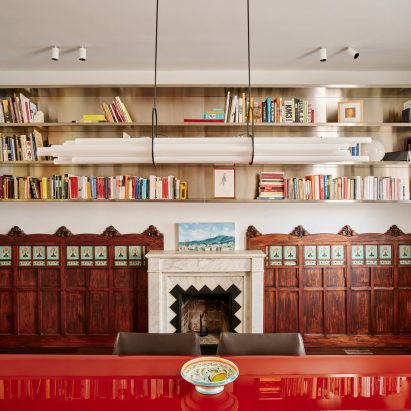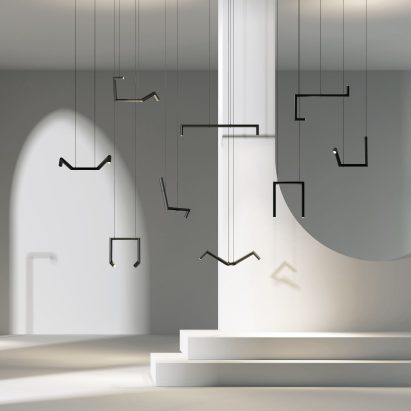

Adam Goodrum's Hangman lighting collection takes its name and its shape from the classic pen-and-paper game, translating the doodled stick figure and blocky letterforms of Hangman into a family of table, floor, and ceiling lights for Australian design brand Rakumba. Each piece is built from an extruded aluminium rod that can be kinked into different geometric compositions, giving the range a playful, sketch-like quality that sets it apart from typical architectural lighting.
A Lighting System Built Around One Clever Joint
The entire collection hinges on a specially designed articulated joint created through a simple 45-degree cut in the aluminium rod. That cut allows a full circular rotation and locks into place with an audible click at each of its possible positions, letting the same basic component be reconfigured into dramatically different shapes depending on how it's rotated and combined.
“I wanted to distil the feeling of putting a pencil to a page, where the possibilities are endless,” Goodrum said of the design. That sense of open-ended drawing carries through the finished pieces: rather than a single fixed silhouette, each lamp reads like a line sketch that has been extruded into three dimensions.
Where the Hangman Concept Comes From
Goodrum drew directly on the mechanics of the Hangman word game, channeling both the playfulness of its central stick figure and the typographic quality of its letter-guessing gameplay. The light source itself appears as a refined, glowing tip at the end of each rod, standing in for the small flourishes that make a hand-drawn Hangman sketch feel personal.
Rakumba's head of design, Dan Treacy, described Hangman as having “the potential to be a future design icon,” noting that the collection “charms with a mischievous edge” while hiding a rigorously engineered product underneath. That combination of playful concept and precise engineering is very much the point: the joint mechanism had to be robust enough for repeated repositioning while still feeling effortless to adjust.
Materials and Finishes
The Hangman collection is offered in two finishes: a raw polished aluminium designed to patina elegantly as it ages, giving each piece a slightly different character over time, and more uniform Black Anodised or Silver Anodised options for buyers who prefer a consistent look across a room. Because the range spans table, floor, and ceiling formats, the same kinked-rod language can be applied across an entire space rather than a single fixture.
Why This Design Approach Stands Out
Modular lighting systems are common, but most rely on straightforward stacking or repeating a single shape. Hangman's rotating joint instead invites genuine improvisation, closer to the “3D drawing” Goodrum describes than to a conventional modular product. That makes each installation effectively unique, shaped by whoever positions the joints rather than dictated entirely by the manufacturer.
The collection also reflects a broader trend in furniture and lighting design toward products that reward hands-on customization rather than arriving in one fixed configuration, giving buyers a stake in how the finished piece ultimately looks in their own space. For more coverage of new lighting, furniture, and product design releases, visit our design news section, and check our broader news coverage for the latest from design brands worldwide.
Hangman Lighting Collection FAQ
Where is the Hangman lighting collection sold?
The Hangman lighting collection is produced and sold directly through Rakumba, the Australian design brand behind the range, across its table, floor, and ceiling formats.
What finishes does the Hangman lighting collection come in?
Buyers can choose a raw polished aluminium finish that develops a natural patina over time, or opt for a more uniform Black Anodised or Silver Anodised finish for a consistent look across multiple fixtures.
Can the Hangman lights be reshaped after installation?
Yes. The articulated joint's full circular rotation means each light can be repositioned into a new geometric composition whenever the owner wants a different look, rather than being locked into a single fixed shape.