The Bartlett School of Architecture's degree show brings together design proposals that tackle migration, memory, and infrastructure, with student projects ranging from a new Polish embassy in Chicago to a fishing center on Lake Kivu in Rwanda. The annual showcase, presented as part of Dezeen's School Shows series, highlights work from University College London's architecture programs, spanning undergraduate studies through advanced Master's units.
Recognized as one of the world's leading architecture schools, the Bartlett uses its Summer Show to present the radical design thinking of its students to a global audience, both online and in person. This year's selection leans heavily on real-world social and political questions rather than purely formal exercises.
A Polish Embassy That Doubles as Civic Infrastructure
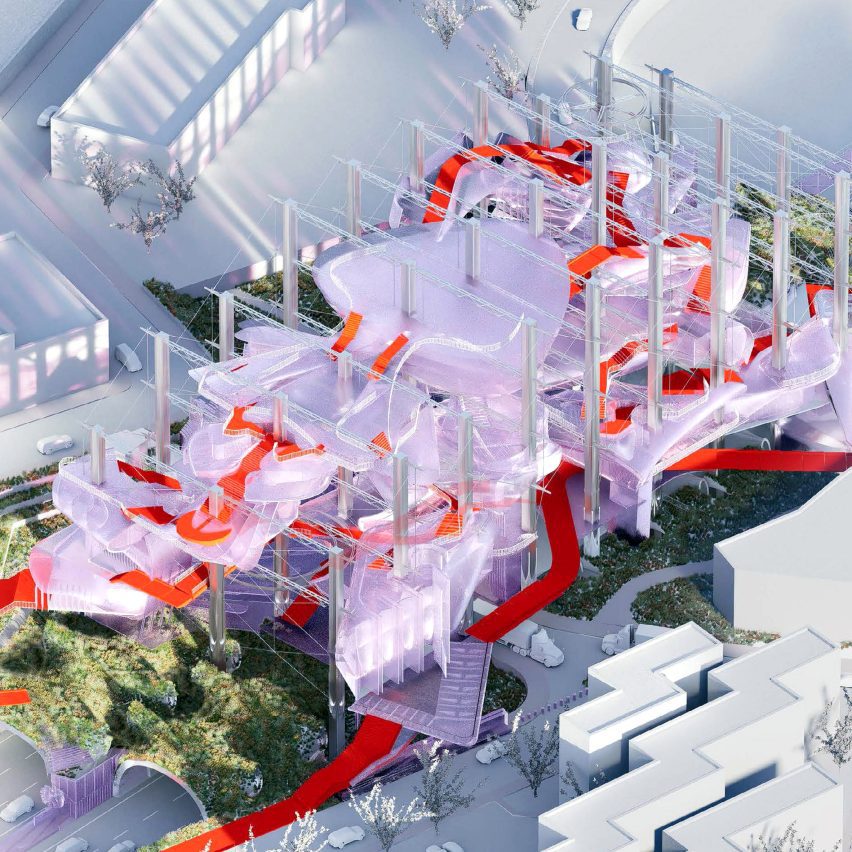
Among the standout proposals is a new Polish Embassy for the United States designed by Matek Zwijacz, responding to what the project describes as a collective historical anxiety rooted in centuries of instability and occupation. Because Poland has repeatedly been governed by governments-in-exile, Zwijacz designed the embassy to double as a temporary seat of government during geopolitical crises.
Located in Chicago, home to the world's largest Polish diaspora, the building spans the Kennedy Expressway, reconnecting communities that the highway had physically separated. Its architectural language reinterprets vernacular Polish ornament through digital fabrication, applying the same visual language to safety infrastructure, circulation, and building form.
Migration, Memory, and Infrastructure as Design Themes
Several other projects use architecture to examine questions of displacement and civic identity. Sergio Lopez's “Ni De Aqui, Ne De Alla” reimagines Chucha.UK, a London-based Latin American media agency, as a way to interrogate the presence and absence of migrant workers within the UK's bureaucratic systems, using storytelling as an architectural method.
On the island of Nkombo in Rwanda, Adam Bigas proposed a Centre for Trimaran Fishermen that celebrates the three-hulled indigenous fishing boat used for night fishing on Lake Kivu, aiming to preserve a sustainable craft that has shaped the island's culture and landscape. In London, Chanunchida Phonoi's “Anatomy of Hidden Rivers” reimagines the hidden water infrastructure near Abbey Mills Pumping Station as a civic landscape of public baths, retention basins, and volunteer programs.
Sustainable Engineering Meets Architectural Ambition
The show also features rigorous technical work. Emily Sturgess's Cob Canopy, an equine and forestry institute proposed for Machynlleth in North Wales, uses a 12-rib glulam dome with curved timber beams and cellulose insulation to cut the building's modelled heating demand from 38 to 9.7 kWh per square meter — a dramatic reduction achieved through material choice rather than added mechanical systems.
Other students explored how emerging technology reshapes design itself. Sze Ho Chan's Galliera Museum of Porticoes proposes an architecture of AI co-authorship, scanning Bologna's historic porticoes to build a customized latent space where design agency is shared between architect and machine — a theme that echoes broader debates happening across our AI coverage about how automation is reshaping creative fields. Lisa Liink's Processing Villa in Venice similarly explores how machine-filtered perception now shapes collective memory and observation.
Why These Student Projects Matter
Degree shows like this one matter beyond graduation season because they surface how the next generation of architects is thinking about pressing civic problems — housing displaced communities, adapting infrastructure to serve the public, and building sustainably in environmentally sensitive regions. Ideas tested here, from Zwijacz's dual-purpose embassy to Sturgess's low-energy dome, often surface years later in professional practice once their creators enter the workforce.
The full show also includes a proposed embassy positioned across the boundary of Vatican City and Rome by Syed Mahe Hussain, a civic mobility hub for Bath Spa Station by Archie Koe blending Gothic and Georgian construction logic, and a rehabilitation center in the Italian Alps by Xiaojing Xu that uses water as both a therapeutic element and an architectural material. For more design and culture coverage like this, visit our news section.