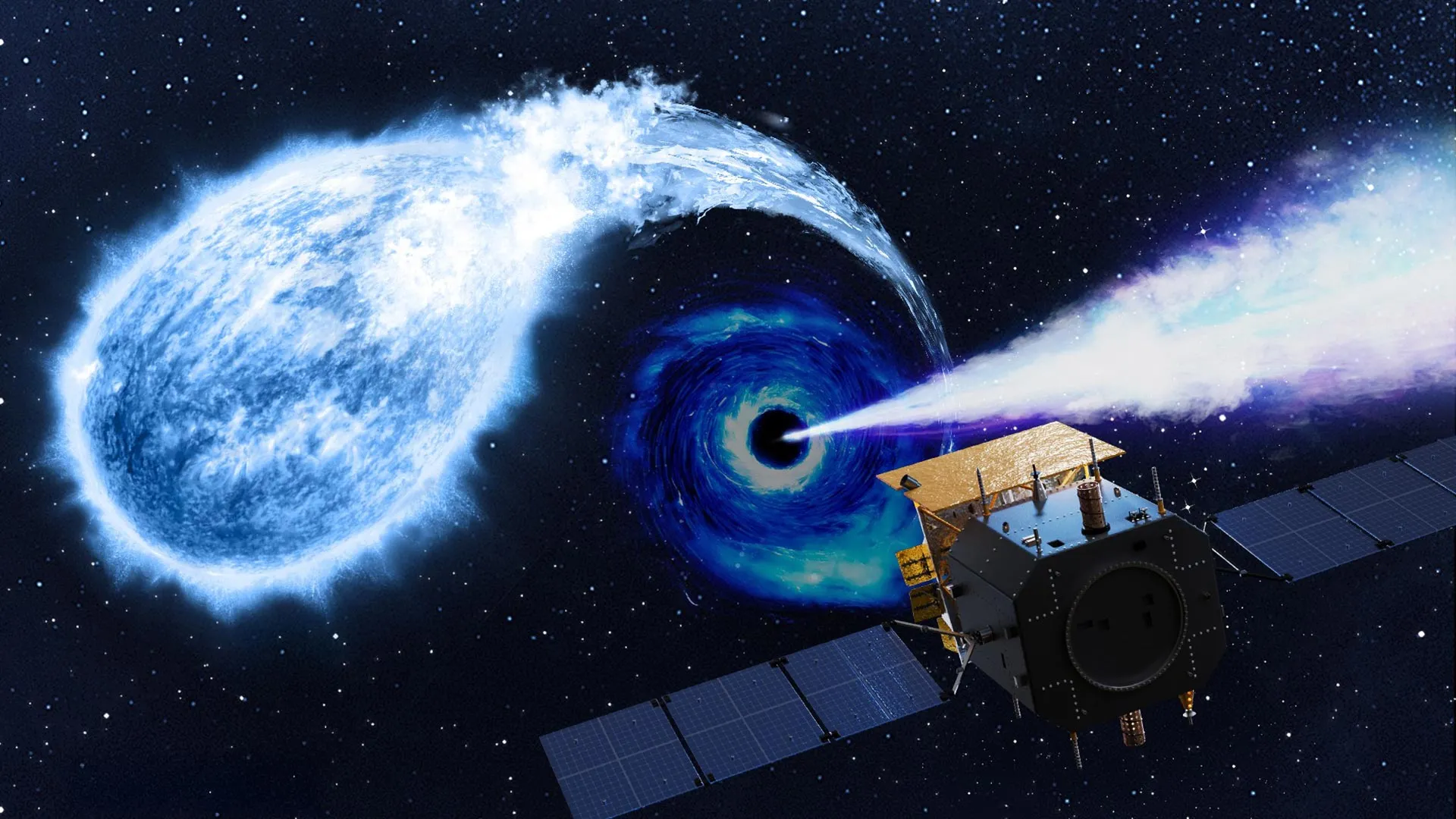
The Einstein Probe may have caught a black hole tearing apart a white dwarf for the first time, recording one of the rarest and most dramatic events in modern astrophysics. The China-led X-ray space telescope spotted an exceptionally bright, rapidly changing source that astronomers now believe is an intermediate-mass black hole shredding and consuming a dense white dwarf star.
An unusual cosmic explosion
On 2 July 2025, during a routine sky survey, the mission's Wide-field X-ray Telescope (WXT) detected a rapidly varying source designated EP250702a, also catalogued as GRB 250702B. At nearly the same time, NASA's Fermi Gamma-ray Space Telescope picked up several gamma-ray bursts from the same patch of sky, prompting observatories around the world to begin urgent follow-up observations.
What made the detection stand out was its sequence. The telescope had already recorded steady X-ray emission from the same spot roughly a day before the gamma-ray bursts arrived, a pattern rarely tied to powerful explosions. About 15 hours after the initial detection, the source erupted into intense X-ray flares, peaking at a luminosity of roughly 3x10^49 erg per second, among the brightest instantaneous outbursts ever recorded.
"This early X-ray signal is crucial. It tells us this was not an ordinary gamma-ray burst," said Dr. Dongyue Li, first author of the paper from the National Astronomical Observatories of China.
Why a black hole feeding event is the best fit
Using the WXT's precise position, astronomers aimed major ground and space telescopes at the source and confirmed it lay on the outskirts of a distant galaxy. The probe's Follow-up X-ray Telescope (FXT) then tracked, in detail, how the event evolved over the following weeks.
- Over about 20 days, the brightness faded by more than a factor of 100,000.
- Its emission shifted from higher-energy "hard" X-rays toward lower-energy "soft" X-rays.
- The outburst occurred in the galaxy's outskirts rather than near its bright central nucleus.
That combination, X-rays beginning before the gamma-ray burst, extreme brightness, rapid evolution and an off-center location, resisted existing models. After weighing the alternatives, the team concluded that one scenario stood out: an intermediate-mass black hole tearing apart and consuming a white dwarf in a so-called tidal disruption event.
What a tidal disruption event reveals
When a compact star strays too close to a black hole, the difference in gravitational pull between its near and far sides can rip it apart, a process astronomers call a tidal disruption. The shredded stellar material spirals inward, heats up and radiates fiercely, which explains the blinding burst of X-rays and its swift decline as the debris is swallowed.
Why this discovery matters
Intermediate-mass black holes, with masses between stellar remnants and the supermassive giants at galaxy centers, are notoriously hard to confirm, and they sit at the heart of long-standing questions about how the largest black holes grow. A white dwarf is also far denser and more compact than an ordinary star, so catching one being devoured offers a rare probe of physics in extreme gravity.
If confirmed, the event would be the first direct observational evidence of a black hole feeding on a white dwarf, a milestone that could sharpen models of black hole growth and tidal disruption. The results appeared as the cover article in Science Bulletin, and the team expects rapid-response observatories like the Einstein Probe to catch more of these fleeting signals.
Frequently asked questions
What is the Einstein Probe?
It is a China-led X-ray space telescope designed to scan wide areas of the sky and catch brief, high-energy transients such as flares from black holes and exploding stars, then point a follow-up instrument at anything unusual it detects.
What is an intermediate-mass black hole?
It is a black hole far heavier than those formed from a single collapsed star but much lighter than the supermassive black holes at galaxy centers. Their rarity makes any new candidate scientifically valuable. For more discoveries from space telescopes, explore our science news.