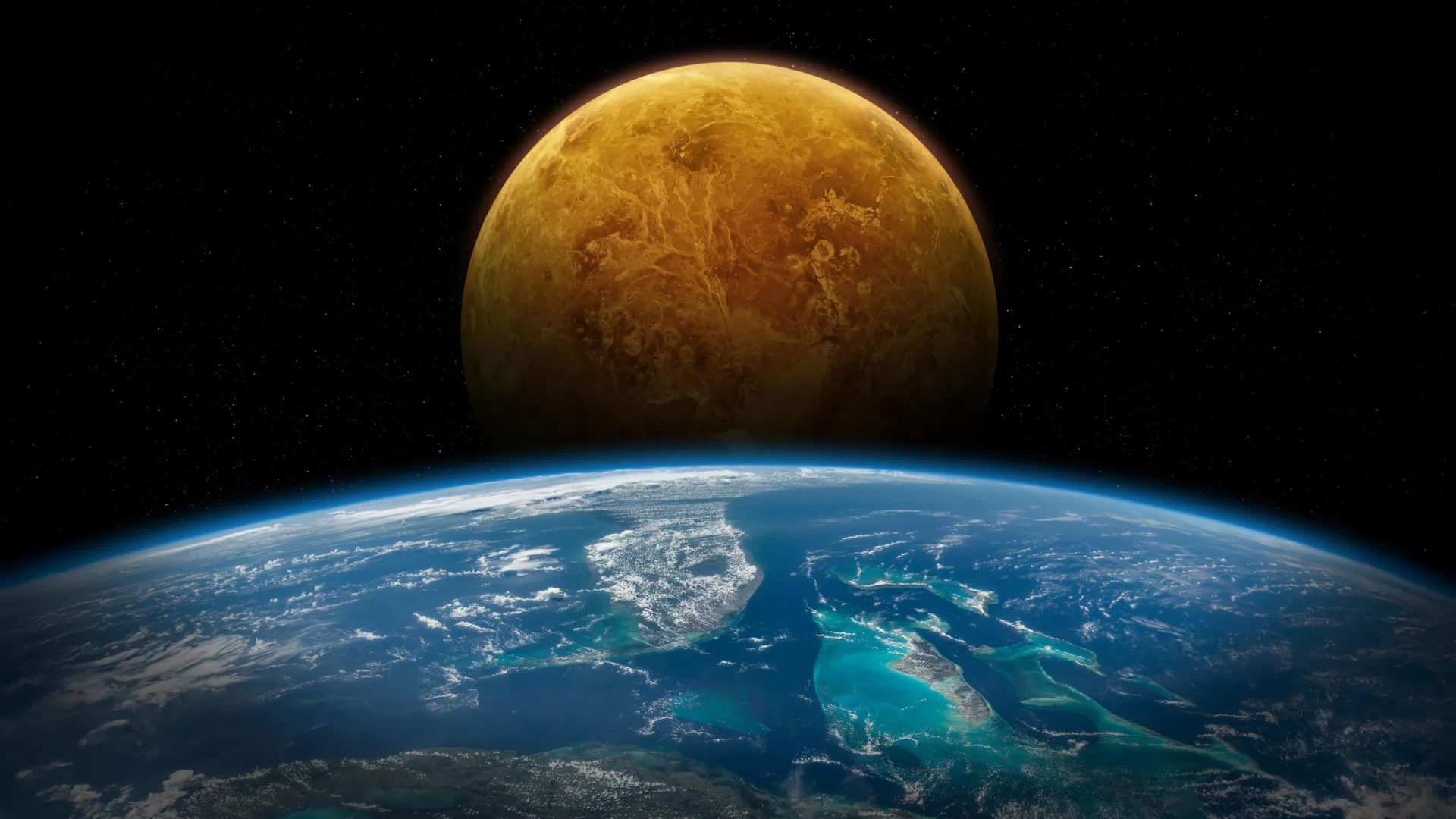
Earth may have been quietly seeding Venus with life for billions of years, according to a new study on interplanetary panspermia. Researchers found that asteroid impacts could launch microbes off Earth into space, where some might survive the journey and end up suspended in Venus' clouds - meaning any life ever found there could potentially trace back to our own planet.
The panspermia idea, applied to Venus
Panspermia proposes that life, or its chemical building blocks, can spread across the cosmos aboard asteroids, comets and other rocky debris. When a powerful impact blasts surface material into space, it can carry microscopic organisms or organic compounds toward other worlds. Scientists have long debated such transfers between Earth and Mars; renewed interest in the possibility of microbial life in Venus' thick clouds has now widened that discussion to include Earth, Venus and Mars as a connected system.
The work was presented at the 2026 Lunar and Planetary Science Conference (LPSC) by researchers from the Johns Hopkins University Applied Physics Laboratory and Sandia National Laboratories. They used the Venus Life Equation (VLE), a framework developed by Noam Izenberg and colleagues in 2021, to estimate how Earth material could introduce life into Venus' atmosphere. Their modeling suggests delivered life could survive in Venus' clouds for at least a few days per century.
Surviving the trip - and the numbers
Material ejected by an impact must endure a brutal gauntlet: the violent shock of launch, intense heat, the vacuum of space, radiation and extreme temperature swings. Prior simulations and meteorite studies show that organic material can survive both ejection and interplanetary travel; on arrival at Venus, it would also need to stay suspended within or above the cloud layers, since the planet's surface is hot enough to melt lead.
To test the idea, the team modeled how fireball meteorites, known as bolides, break up as they enter Venus' atmosphere, using the widely applied pancake model that describes how a bolide fragments and spreads after an airburst. Their preferred estimates produced striking figures:
- Hundreds of billions of cells may have been delivered from Earth to Venus over geological time
- About 100 cells become dispersed through Venus' clouds each Earth year, in the preferred estimate
- Over the past 1 billion years, roughly 20 billion cells may have transferred from Earth
Why this matters for the search for life
The findings carry a sharp implication for astrobiology. If a future probe ever detects biosignatures in Venus' clouds - a prospect that drew global attention after the contested phosphine detection of 2020 - scientists will face a fundamental question: did that life arise independently on Venus, or did it hitchhike from Earth? This study makes the second answer scientifically plausible, complicating how any such discovery would be interpreted.
The researchers stress that every VLE parameter carries large uncertainty, much like the famous Drake Equation, and the model does not capture every interaction with Venus' atmosphere. Even so, the work supports the possibility that panspermia between the two planets could occur. For more on planetary missions and astrobiology, browse our science coverage, and follow the search for life across the solar system in our latest space news.
Venus panspermia FAQ
Does this prove there is life on Venus?
No. The study only models whether Earth microbes could plausibly reach and briefly survive in Venus' clouds. No life has actually been detected there; the work is about possibility, not confirmation.
How would microbes survive on Venus?
Only in the cloud layers. Venus' surface is extraordinarily hot and crushing, but its upper clouds have milder temperatures and pressures where, in theory, suspended microbial life could persist for short periods.