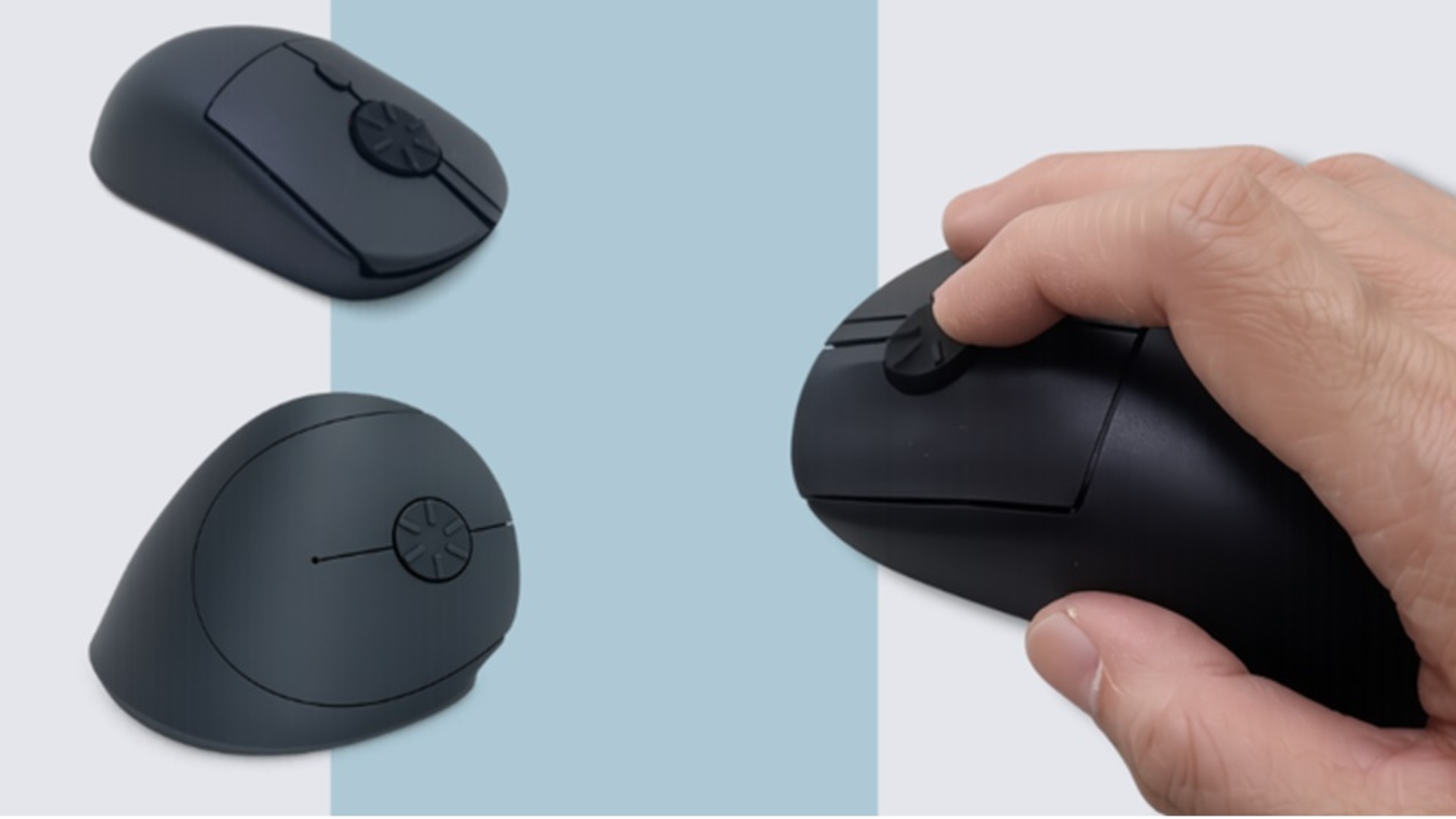
The Rotary Mouse reimagines a component that has barely changed in three decades — the scroll wheel — by replacing it with a continuous rotary dial its maker claims can move through documents up to 2.5 times faster than a standard wheel. Instead of repeated up-and-down flicks, you turn the dial like a small knob, controlling speed and direction through motion and pressure.
A different kind of scroll
The whole pitch rests on a single mechanical swap. Where a normal mouse uses a notched wheel, the Rotary Mouse uses a smooth rotating dial that its creator says feels closer to turning a knob than clicking a switch. The campaign claims this rotary input lets users scroll or scrub up to 2.5x faster while reducing the repetitive strain that comes from constant flicking.
Importantly, it still supports conventional vertical scrolling, so you can switch between familiar and rotary control without changing devices or habits. The dial also adds tactile clicks during rotation, intended to help you keep control at higher speeds and stop precisely on a timeline or page. If you keep tabs on unusual PC peripherals, this is one of the more genuinely novel input ideas in a while.
Specs and hardware
- Dimensions: 119 mm x 64 mm x 40 mm, matte black ergonomic shell
- Weight: 59 g without battery
- Connectivity: 2.4 GHz wireless via USB receiver
- Sensor: optical, switchable 800 / 1200 / 1600 DPI
- Power: one AAA alkaline battery (included)
- Compatibility: Windows, Linux, macOS, and Android
The left and right buttons are silenced, and the middle button is built directly into the rotary wheel itself. Testers describe the motion as fluid and easy to control, particularly for stopping at exact points.
Where it shines: editing and sim racing
Early adopters have leaned on the device for timeline scrubbing in video editing software, where fine, repeated control matters. In apps like Adobe Premiere Pro and DaVinci Resolve, turning the dial moves through footage more smoothly than repeated scrolling. The concept extends to sim racing, too: the rotary input can be mapped to steering, turning the dial into a compact alternative to a wheel or keyboard. That makes it intriguing for gradual-steering titles such as Euro Truck Simulator 2, Assetto Corsa, and BeamNG.drive. Sim-racing fans who watch new gaming gear should note this is still experimental.
Who's behind it — and the caveats
The creator, electronics engineer Melvin Wong, says the idea grew out of a desire to reduce finger strain during long computer sessions. Prototypes were 3D-printed before evolving into early production units, and Wong says continuous rotation cut repetitive strain while unexpectedly improving navigation speed during testing. That said, independent verification of the speed claims remains limited, and real-world performance likely depends on the user and the application.
The Rotary Mouse is currently crowdfunding on Kickstarter, where it has raised $3,654 against a $14,794 goal from 61 backers, with 18 days left in the campaign. The team says it has already sold more than 30 pre-production Founder’s Edition units and aims to start shipping the final product by December 2026. As with any crowdfunding project, backers should weigh the usual risks of delays or non-delivery.
Frequently asked questions
How much faster is the Rotary Mouse?
The maker claims up to 2.5x faster scrolling than a standard mouse wheel, though independent verification of that figure is currently limited.
What devices does it work with?
It supports Windows, Linux, macOS, and Android over 2.4 GHz wireless using an included USB receiver.
When will the Rotary Mouse ship?
The team is targeting December 2026 for final units and says it has already sold more than 30 pre-production Founder’s Edition units.