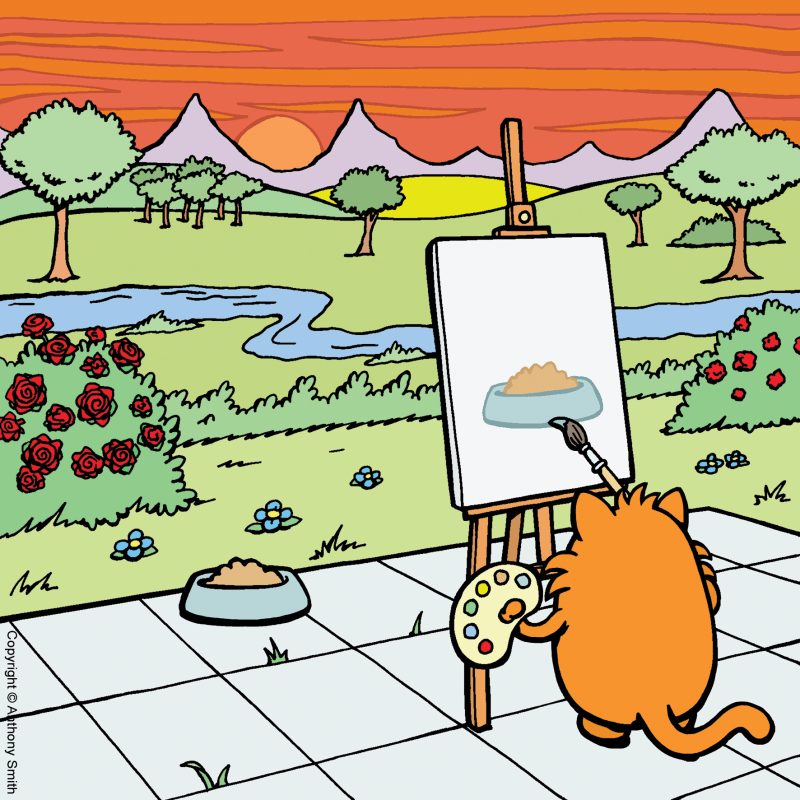
Cartoonist Anthony Smith, the creator behind Learn to Speak Cat and Cattitude-Doggonit, has built a career imagining what pets are really thinking. His comics explore the mysterious, mischievous inner lives of cats and dogs, translating familiar feline behavior into wry one-liners. But his road to pet humor began long before cats took center stage in his work.
From comics collector to working cartoonist
Smith started drawing cartoons very young, inspired by the comics he read and the vibrancy of each panel. He became an avid collector, amassing piles of comics and cartoon compilations that he still keeps today. That early immersion shaped both his taste and his ambition.
He turned professional at a young age as well, drawing first for a local newspaper and soon after for Marvel UK, where he produced puzzle pages for the publisher's children's comics. The leap from hobbyist to working artist gave him an early grounding in deadlines, formats and audience.
A substantial background in advertising, plus experience in graphic design, typography and art direction, went on to shape his style. Smith says it made him far more conscious of a cartoon's overall design, favoring work that is impactful and clear rather than cluttered, an instinct that carries directly into the clean read of his cat panels.
Finding the voice of cats
Smith set out to do something different by imagining cats with their own language, communicating with one another and trying to reach the humans around them. He often places cats in human-like situations or gives them human characteristics, noting that people naturally project their own traits onto the animals that share their space. That projection is the engine of the joke: readers recognize themselves in the cat.
Interestingly, he does not currently have a cat, though he says that could change. He still finds endless inspiration by observing cats and dogs elsewhere, keeping his radar up for any gesture or expression he can turn into a cartoon. Asked what he would do with the power to speak cat for five minutes, his answer is a single pointed question: what do they really think of us. For more feline features, explore our pet and lifestyle coverage.
Lessons, community and charity work
Smith credits pets with teaching patience and spontaneity, and with a knack for taking life as it comes rather than dwelling on problems. That outlook bleeds into the comics, which find comedy in everyday domestic moments rather than grand setups.
Over time he has built a mixed audience across platforms such as Facebook and GoComics, where his strips reach both dedicated comics readers and casual pet lovers. He has also put his art to charitable use, donating original work and prints to organizations including:
- Cats Protection in the UK
- The Cat Network in the USA
The donations tie his creative output back to the welfare of the animals that inspire it, a fitting loop for an artist whose whole catalog is built on affection for pets.
His advice for aspiring creators and owners
Smith closes with practical guidance on both pet ownership and the creative life. Caring for a pet, he stresses, is a serious lifelong commitment that should not be taken lightly, a grounding note beneath the humor.
For aspiring creators, he recommends self-publishing through social media to build an audience directly, and keeping a parallel career, ideally a creative one, since surviving on cartooning alone is difficult. And on the question of who is really in charge once a pet moves in, his answer is simple: they are. Find more creator features in our latest stories.
Frequently asked questions
What comics is Anthony Smith known for?
He is the cartoonist behind Learn to Speak Cat and Cattitude-Doggonit, strips that imagine the inner thoughts of cats and dogs.
Does Anthony Smith own a cat?
Not at present, though he says that could change. He draws inspiration from observing cats and dogs around him rather than from a pet of his own.
What is his advice for new cartoonists?
Self-publish through social media to build an audience, and keep a parallel career, preferably a creative one, because making a living from cartooning alone is very hard.